
The Dictionary: Fighting Rare Disease with the Power of Words
Written by Archith Shah
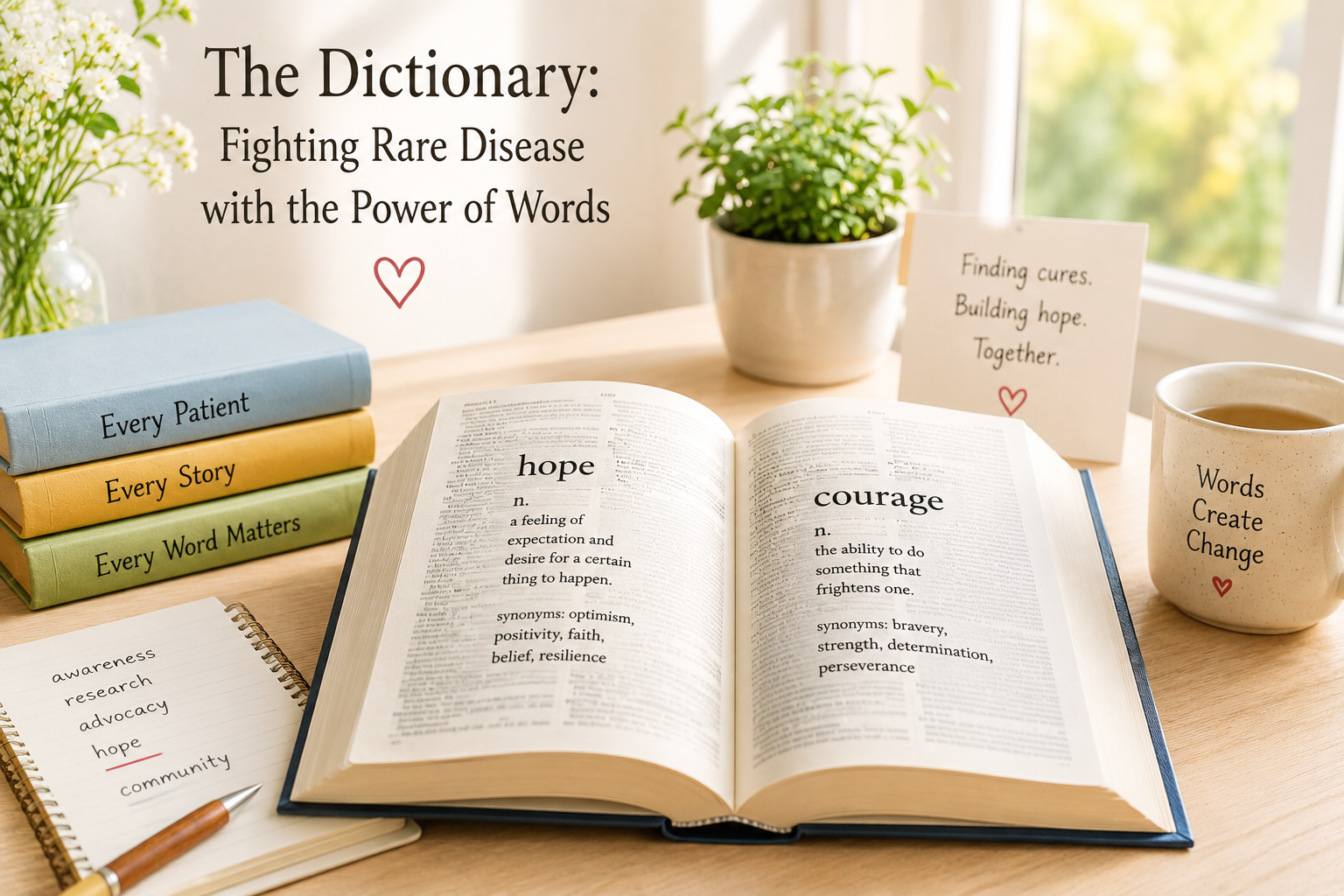
The first word that scared me was not “rare.”
It was a word I couldn’t even pronounce.
It was close to midnight when I first opened the reports properly. The entire house was asleep, but I sat alone under a dim light, surrounded by papers that felt heavier than they should have.
I thought I would find answers in those pages.
Instead, I found a language I didn’t understand:
Neuromyotonia.
Fasciculation.
Electromyography.
Then another.
Electromyography.
I reread the same lines again and again, hoping they would suddenly make sense.
They didn’t.
And that terrified me more than I wanted to admit.
Because somewhere deep inside, I already knew something was wrong with me. My body had been whispering it for months. But the moment doctors called my condition “rare,” everything changed.
Not just medically.
Emotionally.
Suddenly, every hospital conversation sounded different. Doctors spoke in long sentences filled with words that floated right past me. Family members tried to stay calm. I nodded politely during appointments as if I understood everything.
But inside my head, there was only one question repeating itself:
What does all of this mean? What happens to me now?
At night, I searched endlessly online.
That became my routine.
One medical term would lead to another. One article would contradict the next. Some websites gave hope. Others felt like a death sentence written in scientific language.
I still remember one particular night when I spent nearly an hour searching for the meaning of a single term. By the end of it, I wasn’t wiser.
That is something people rarely talk about when it comes to rare diseases.
The symptoms hurt.
But uncertainty can hurt even more.
I would sit in waiting rooms holding my reports so tightly that my hands hurt. Around me, other patients looked strangely calm. Some chatted with relatives. Some scrolled through their phones. A few even laughed.
I kept wondering:
Do they understand their reports better than I do?
How are they so calm?
What am I missing?
That question stayed with me for days.
And then, I stopped running away from the words.
Instead, I started learning them.
One by one:
Antigen: a foreign substance that triggers defence.
Antibody: the body’s shield against invaders.
Atrophy: the wasting away of tissues.
Plasmapheresis: a process to filter blood plasma.
For the first time in months, I felt something unexpected.
Not fear but a tiny power.
The strange thing about these difficult words was:
The more I understood, the stronger I became emotionally.
Every day, I learned a little more.
Not to become a doctor.
Not to impress anyone.
But to survive better.
Slowly, hospital conversations started sounding less frightening.
And then came a moment I will never forget.
During one appointment, a doctor casually used the word “atrophy” while discussing my condition.
Months earlier, hearing that word would have destroyed my peace for days. I would have gone home, searched the internet endlessly, imagined the worst possible outcomes, and barely slept.
But this time was different.
This time, I understood the word completely.
For the first time, I calmly asked a follow-up question instead of silently panicking.
The doctor answered normally.
For the first time, I did not feel like a lost patient.
I felt involved in my own life again.
That feeling is difficult to explain unless you’ve experienced it yourself.
Understanding medical language did not cure my illness.
But it gave me something I had lost:
Control.
I could finally:
Read reports without panicking instantly.
Track symptoms clearly.
Ask smarter questions.
Understand treatment discussions.
Read research papers without feeling terrified.
Explain my condition to others in simple language.
But somewhere during this journey, I discovered something even more important.
The most healing words in my life were never medical words.
They were human ones.
One evening, during one of my hardest phases, my mother looked at me quietly and said:
“You don’t worry, we’ll get through this.”
That was it.
No scientific explanation.
No miracle promise.
Just a simple sentence.
But somehow, those ordinary words carried more strength than every complicated medical term I had learned.
And then came other forms of healing, too:
Friendship.
Humour.
Heartfelt conversations.
Hope.
Even laughter.
Especially laughter.
Because when your body becomes unpredictable, laughter reminds you that your spirit is still alive.
And sometimes, that matters more than people realise.
Redefining Victory
Before illness, success meant achievement to me.
Now success looks very different.
Success is understanding one more report without fear.
Success is asking one confident question in a hospital room.
Success is walking into an appointment feeling prepared instead of terrified.
I still remember one hospital visit very clearly.
That day, I walked in carrying notes I had prepared myself. Questions. Observations. Medical terms I finally understood.
For the first time, I was not intimidated.
I spoke calmly.
The doctor listened carefully.
And while walking out of the hospital, I noticed something strange.
I felt taller.
Nothing about my illness had magically improved overnight.
But I felt better.
The Bigger Lesson
Rare disease taught me something most people never think about:
Language can imprison you.
But language can also free you.
The moment you understand the words surrounding your condition, fear loses some of its power.
Not all of it.
But enough to breathe again.
Enough to think clearly.
Knowledge did not cure me.
But it gave me direction.
Where I Stand Today
Things aren’t perfect. But they don’t have to be…
I still have difficult days. I still face uncertainty. I still carry questions no report can fully answer.
But I am no longer lost in silence.
I feel more prepared.
Words had trapped me, but they set me free, too.
And somewhere between the sleepless nights, and the terrifying reports…
I found my voice again.
